


Home - TEXEL

AI Data centers &

Infrastructure - Off-grid

About TEXEL

TEXEL’s technology platform has been consolidated through targeted acquisitions and long-term collaborations with internationally recognized research institutions and industrial partners. Through exclusive licenses, integrated intellectual property, and accumulated engineering assets with an estimated development value exceeding USD 2 billion, TEXEL has built a scalable and defensible energy infrastructure platform.

Challenges in Energy

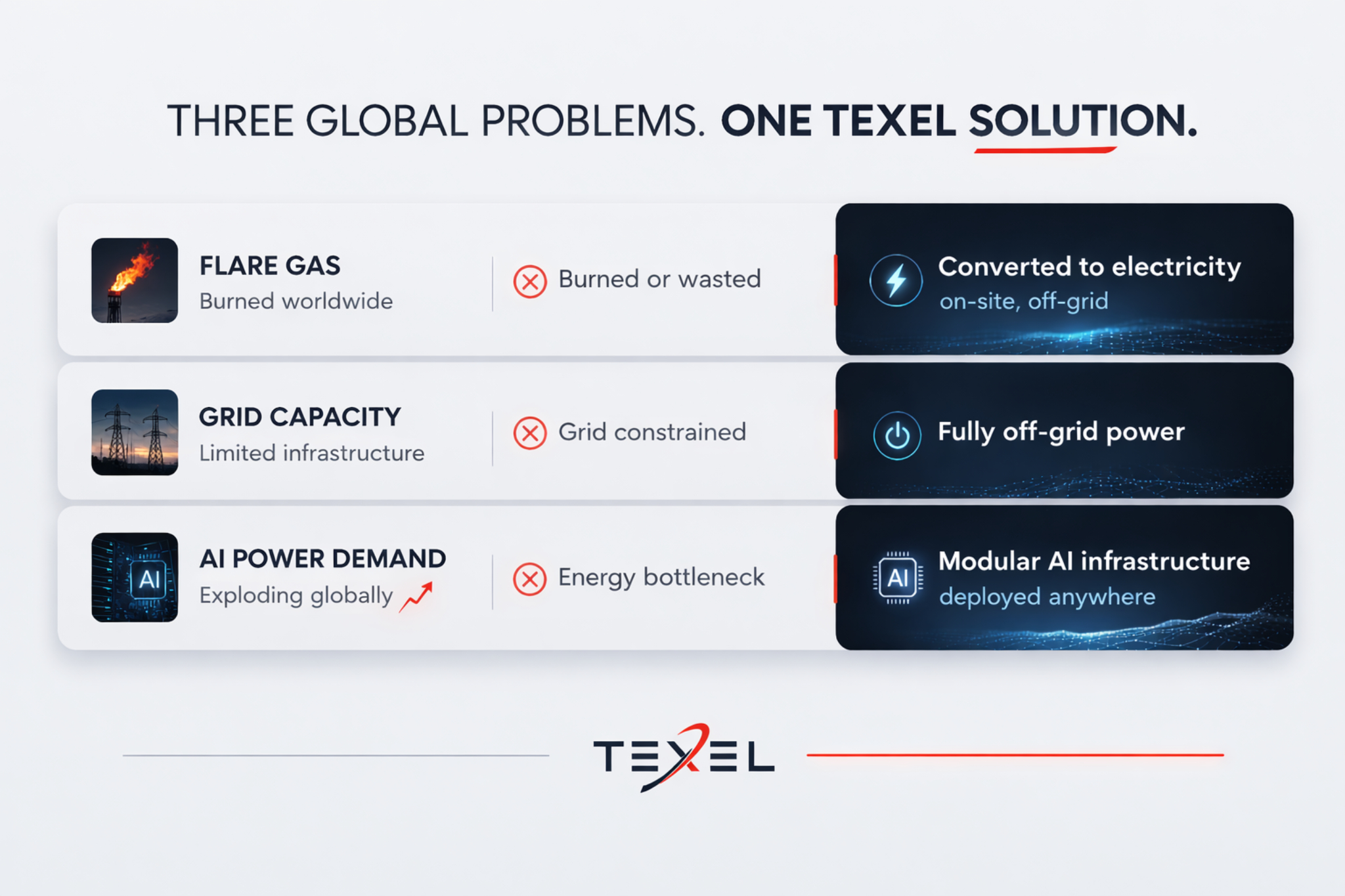
Global electricity demand is accelerating faster than grid infrastructure can expand.

AI data centers, industrial electrification, and digital systems require reliable, scalable power — yet transmission constraints and permitting timelines limit capacity growth.

Meeting this demand requires resilient, cost-efficient, circular energy systems that reduce waste, avoid rare earth dependence, and deliver dispatchable power wherever it is needed.

Global electricity demand is increasing at a pace that challenges both generation capacity and transmission infrastructure. AI data centers, electrification, and industrial growth are accelerating this trend, placing significant pressure on energy systems worldwide.

Meeting this demand requires cost-efficient, scalable, and resilient energy solutions that operate reliably under all conditions.

However, not all energy technologies are equally sustainable. Long-term energy systems must reduce resource intensity, minimize environmental impact, and avoid over-reliance on rare earth minerals and other constrained materials.

A robust energy transition depends on circular, dispatchable solutions capable of delivering stable power—day and night, independent of weather conditions, and without introducing new structural vulnerabilities.

Making energy solutions available

TEXEL delivers modular, grid-independent energy systems designed to make reliable power available where and when it is needed most. 

As electricity demand accelerates—driven by AI data centers, industrial electrification, and digital infrastructure—power availability has become a structural constraint. TEXEL’s integrated heat-to-power and storage platforms provide cost-efficient, dispatchable energy without relying on new grid expansion. 

The result is scalable, circular energy infrastructure capable of supporting high-demand environments while reducing resource intensity and avoiding rare earth dependence.

Since its inception, TEXEL has centered its platform on one core capability: converting thermal energy into reliable electricity.

This foundational expertise has evolved into a broader, industrialized energy platform capable of capturing, storing, and converting heat across multiple applications. TEXEL’s systems enable electricity-to-heat storage, direct thermal storage, and the controlled conversion of stored heat into combined heat and power (CHP).

The platform also supports direct electricity production from bio-based fuels and waste gases, as well as the recovery and utilization of industrial waste heat streams. These integrated capabilities position TEXEL as a flexible energy infrastructure provider—capable of delivering dispatchable power solutions across diverse industrial and data center environments.


Rather than focusing on a single energy source, TEXEL operates as a thermal energy conversion and storage platform—designed for modular deployment, system integration, and scalable commercial application.

TEXEL’s energy storage platform is engineered for large-scale deployment and long operational life. Designed around circular principles, the system avoids reliance on rare earth minerals and other constrained materials.

Unlike conventional battery technologies, the platform is based on thermal storage concepts that exhibit minimal cyclic degradation and long service intervals. This enables durable energy buffering and long-duration storage with limited performance loss over time.

By reducing material intensity and supply-chain dependency, TEXEL’s storage systems strengthen grid resilience and support reliable integration of high-demand infrastructure — including AI data centers and industrial applications.

The result is a scalable storage solution positioned for long-term infrastructure investment rather than short-cycle replacement.

TEXEL operates a proprietary heat-to-power conversion platform engineered for scalable, industrial deployment.

Built on proven thermodynamic principles and refined into a commercial energy system, the platform converts thermal energy into dispatchable electricity with stable output and modular scalability. It is designed for integration into demanding environments, including AI data centers and industrial facilities.

The system’s versatility enables deployment across a range of applications where reliable power is required but grid capacity is constrained.

Rather than supplying standalone components, TEXEL delivers integrated energy infrastructure capable of supporting high-demand operations with predictable performance and long service life.

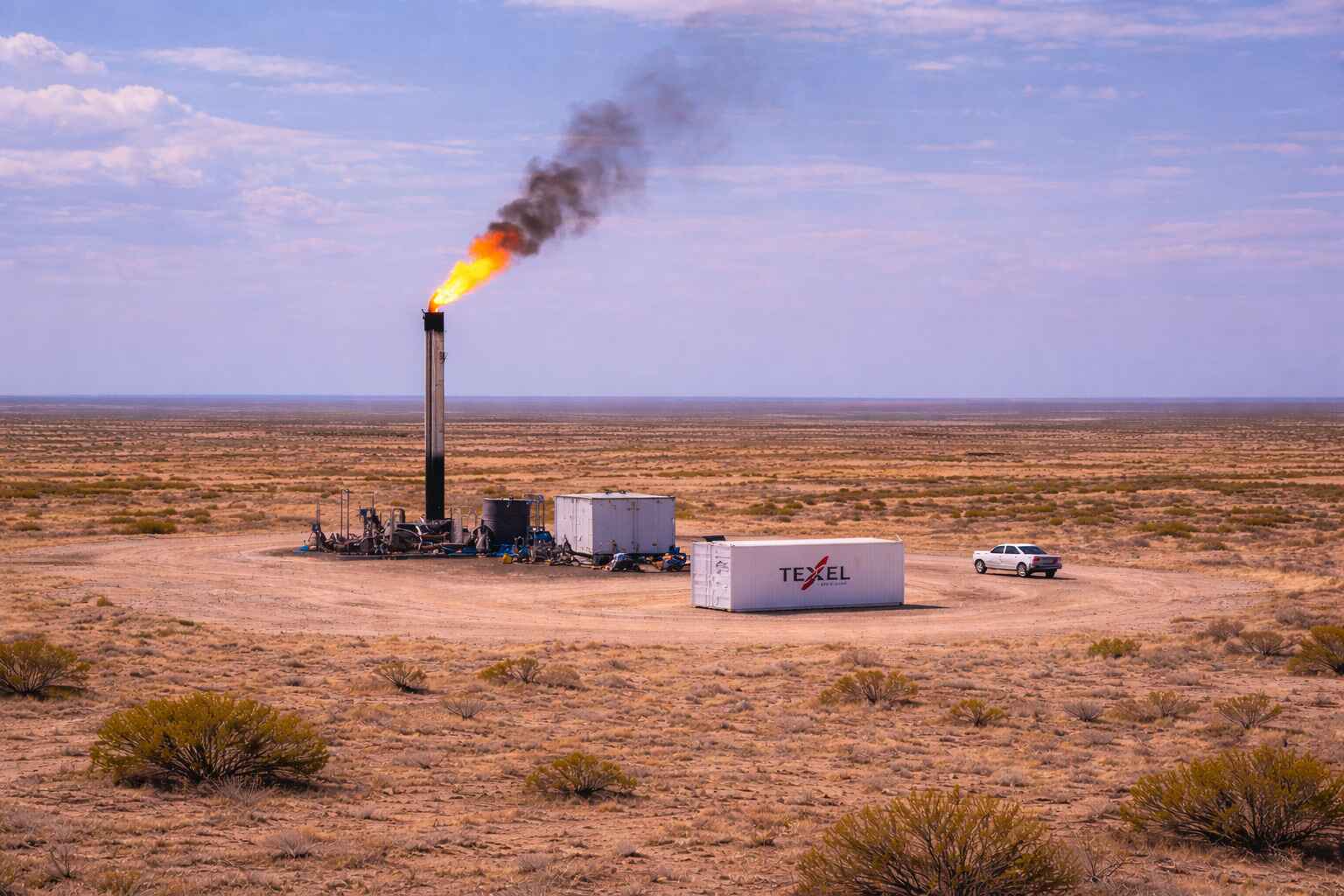
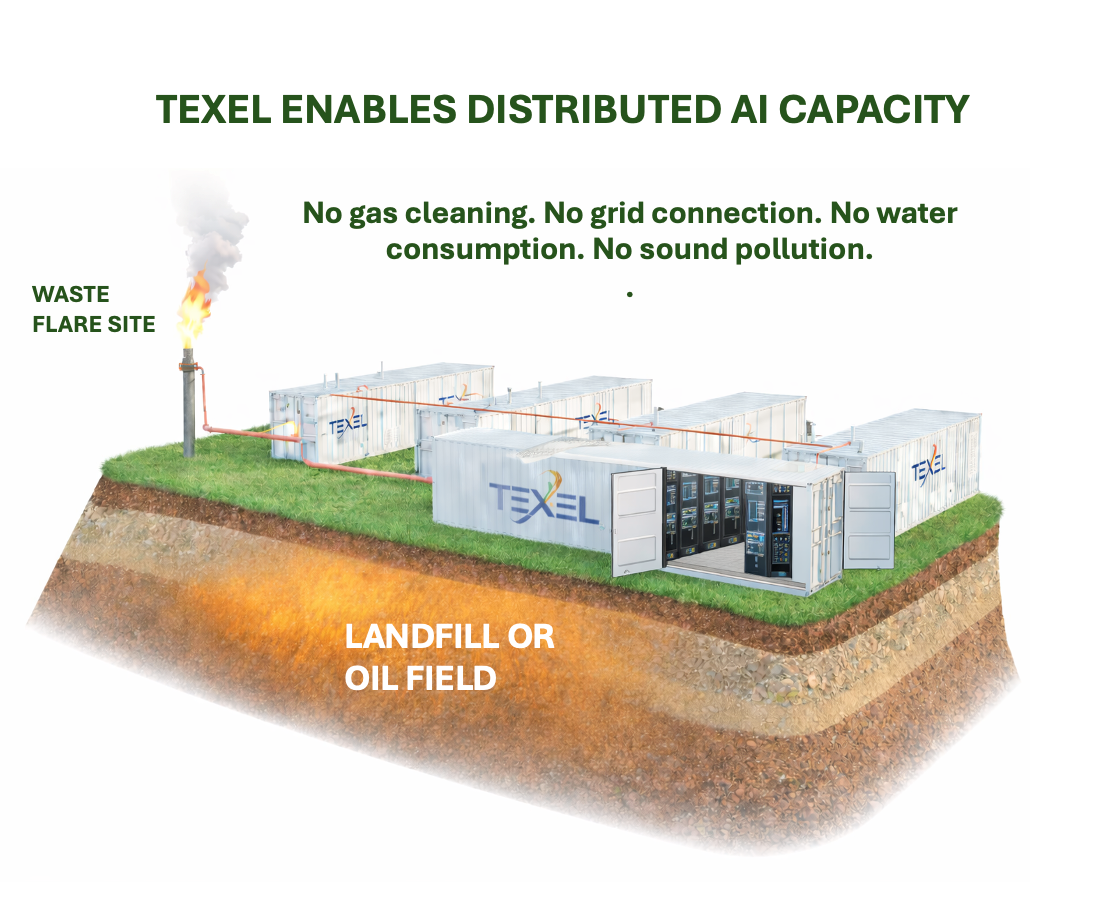
TEXEL’s patented heat-to-power platform converts waste heat from industrial processes, landfills, and flare sites into dispatchable electricity — transforming stranded thermal energy into infrastructure-grade power.

Rather than relying on combustion-based generation, the system captures thermal energy directly and converts it into stable electrical output. It tolerates low-quality gas streams with minimal pre-treatment, enabling modular deployment at the point of energy release.

Each unit delivers 250 kW of firm capacity and can be scaled incrementally to multi-megawatt installations. The systems are engineered for continuous operation and designed for direct co-location with AI data centers and industrial facilities.

By producing power where energy is otherwise wasted, TEXEL enables grid-independent deployment of high-demand infrastructure — without adding pressure to existing transmission networks.

The result is compute-ready electricity derived from overlooked energy streams, delivered as an integrated energy infrastructure solution.

Global cooperation

TEXEL Energy was founded in Sweden but is built on global cooperation that extends across Europe, the USA, and Australia. New game-changing technology demands collaboration with the best in each specific field.

Collaborations and Acquisitions:

TEXEL has built its foundation through strategic acquisitions and exclusive collaborations with world-leading research institutions. With two exclusive licenses and accumulated assets valued at over USD 2 billion, the company holds a unique competitive edge in delivering scalable and truly green energy solutions.

TEXEL was originally founded through the acquisition of the rights to a unique Stirling engine technology, initially developed by Ford Motors in collaboration with submarine manufacturer Kockums. This acquisition became the cornerstone of TEXEL’s innovative approach to energy.

Soon after, TEXEL expanded its technological capabilities by acquiring Stirling Energy Systems and Maricopa Solar in Arizona, which enabled a productive collaboration with the U.S. Department of Energy’s Solar Laboratory, SANDIA National Laboratories.

Building on these foundations, TEXEL established an exclusive collaboration with the Savannah River National Laboratory (SRNL) and Curtin University in Perth, Australia. As part of these collaborations, TEXEL secured two exclusive licenses covering key elements of the technology platforms—further strengthening the company’s strategic position.

The company’s broader strategy has also included acquiring key assets from two Nasdaq-listed companies, which has reinforced TEXEL’s role in the sustainable energy sector and aligned with its mission to deliver scalable, circular, and truly green energy solutions.

Most recently, the acquisition of selected technology components from the Nasdaq-listed companies Swedish Stirling and Azelio has contributed to TEXEL’s overall technology platform. Taken together, the patents, R&D, know-how, exclusive licenses, and other assets accumulated by the company over the years represent a development value estimated at more than USD 2 billion—providing TEXEL with a unique competitive edge and strong entry barriers in the global energy market.

Industrial-Scale Production Capacity

TEXEL is scaling toward giga-level production, building on manufacturing assets acquired in Sweden with an annual capacity of approximately 10,000 modular units — equivalent to roughly 200 MW of deployable power capacity.

The company’s next step is establishing U.S.-based production to support large-scale deployment of grid-independent energy systems for AI data centers and industrial applications, followed by expansion into Europe.

To meet accelerating electricity demand — particularly from AI data centers and high-density infrastructure — scalable manufacturing capacity is essential.

TEXEL has consolidated production assets, intellectual property, and industrial tooling to support high-volume system manufacturing. The integrated platform enables modular assembly, repeatable deployment, and standardized installation across multiple sites.

With an annual capacity of approximately 10,000 units (≈300 MW), the production model is designed for expansion toward giga-scale output through strategic supplier partnerships and regional manufacturing hubs.

The first phase focuses on establishing U.S. production to support American infrastructure deployment. Subsequent expansion will extend manufacturing capacity into Europe and other strategic markets.


This industrial approach ensures that TEXEL operates not only as a technology provider, but as a scalable energy infrastructure manufacturer capable of supporting multi-megawatt AI deployments.

Behind the Innovation

TEXEL’s concept and business model are built on global collaboration, uniting world-leading experts, laboratories, and companies. Development and operations are coordinated by the TEXEL teams in Sweden, the United States, and the United Kingdom.

Company Structure​

Over the years, TEXEL has built a legal structure with corporate entities in Sweden, the UK, and the USA, designed to provide the optimal conditions for achieving the company’s objectives in R&D collaborations, financing, industrialization, and commercialization.